Guides / apartments
Moving out of a Hornsby apartment
Two in three Hornsby addresses are units, and in Waitara it is closer to nine in ten, so this is the local move. The load is rarely the hard part. The building is. Here is the sequence that keeps a unit move out of the lobby.
Two weeks out: talk to the building first
Every managed building has rules about moving, and finding them out on the day is the most expensive way to learn them. One email to your building manager or strata contact answers the four questions that shape the whole move:
- Does the lift take bookings? Most mid-rise buildings around the station do. Book a morning window if you can get one; lifts are quietest before the building wakes up properly.
- Is there a loading bay or dock? If yes, how long can a truck stand in it, and does it need its own booking?
- Does the building need paperwork from the removalist? Some managers ask for an insurance certificate before they will confirm a booking. Ask us for whatever the building needs when we call back, and we sort it before the day.
- Are there protected hours? Plenty of buildings only allow moves inside set hours on set days. Better to design the day around that than discover it at 8am.
One week out: pack for a lift, not a hallway
Unit moves reward packing discipline more than house moves do, because everything funnels through one door and one lift. The habits that save real time:
- Uniform boxes, properly sealed. A trolley stacks four same-sized boxes; it stacks one odd-shaped bag. Uniform boxes are the difference between six lift trips and ten.
- Stage by the door. On the morning, boxes staged in the hallway near the front door mean the crew feeds the lift continuously instead of walking deeper into the unit each trip.
- Label by destination room, not by origin. "Kitchen" on a box means something at the new place; "cupboard" does not.
- Keep a first-night box aside. Kettle, chargers, sheets, the things you need before the unpack starts. It rides in the car, not the truck.
The day: how the crew runs it
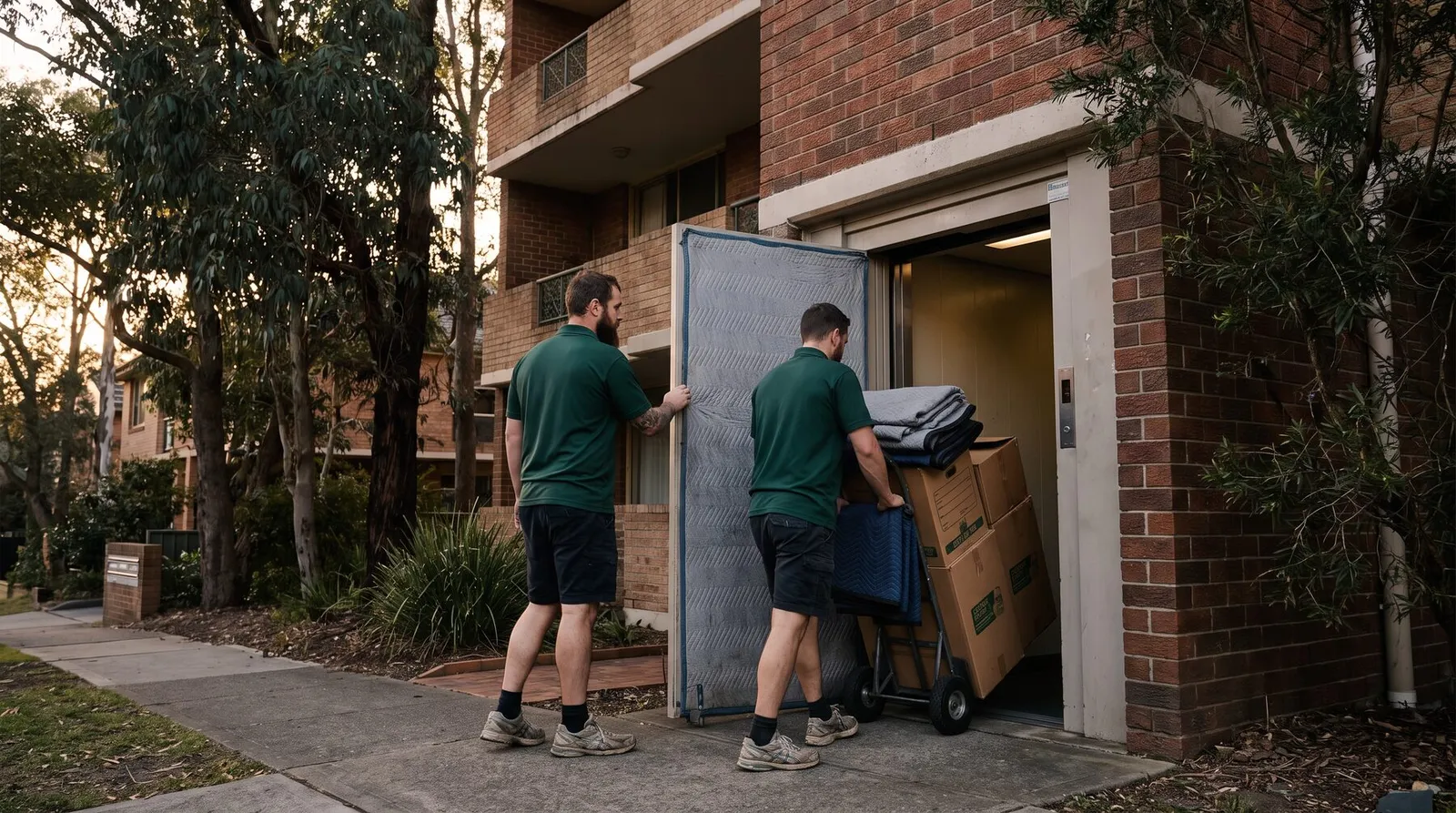
A well-run unit move is choreography. The truck arrives inside the booked window and stands where the building expects it. Pads go up in the lift if the building has not fitted its own. One mover works the unit, wrapping furniture and loading the trolley; one runs the lift and the truck. The lift is never sent down empty and never left waiting full. That rhythm is why unit moves run the 2-mover crew at $250 an hour off the published card: in most lift buildings a third mover just queues in the lobby.
Where a unit move genuinely earns a bigger crew, like a walk-up with stairs at both ends, we say so when we call back, with the reason attached.
After the truck: the bond clock
Most Hornsby and Waitara unit moves run against an end of lease, which means the move is not really finished until the keys go back. Plan the tail of the day backwards: the bond clean needs the unit empty, the agent needs the keys by a set time, and the final meter photos want an empty room. Tell us the key deadline on the form and we plan the finish, not just the start.
The short version
- Email the building manager two weeks out: lift, bay, paperwork, hours.
- Book a morning lift window and tell us what it is.
- Uniform boxes, staged by the door, labelled by destination.
- Keep the first-night box in the car.
- Plan backwards from the key handover, not forwards from the start time.
Do those five and any decent crew, ours included, will move you faster. That is the point of the guide.